
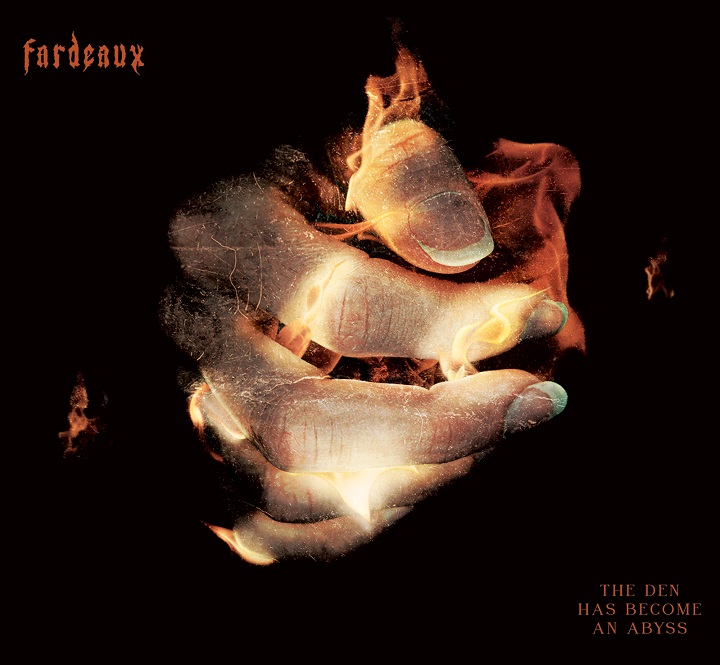
Three independent tracks released over the past couple years have foreshadowed a new dark force brooding over France, and the greater pitch-black vastness glimpsed among those pieces is now manifest, with FARDEAUX engaging a first full plunge into its lawless substance. Consistent with a name translating to “Burdens,” these orchestrators weave tormented energies and dread across the aural planes of The Den Has Become an Abyss, and their intensity fulfills many grim prospects alluded within the formative works mentioned above. Rapturous elements are present, but they are kept at a distance amid the unrelenting madness, and other mesmeric properties also take effect during the course of this venture, making The Den Has Become an Abyss an opus laden with dynamic paths that pursue a different type of deliverance.
Upheaval begins in a battering riff on “Siéger Sur Le Trône De La Honte Et Du Mépris,” and it merges with erratic shifts in vocal and drum patterns to drive the rising turbulence. This force is central to many arrangements, but the maelstrom here also subsides to bring out a melodic element, and it casts an elevated tone through cold and arpeggiated surroundings that ultimately carry its expansion toward multiple rounds of leadwork. Strange fragmenting effects are accented within the soloing to heighten its otherworldliness, and strings contorting from another dimension are observed when blast beats commence alongside icy speed riffage. Similarly disturbed waves are even more pronounced after crossing the ambient void of “Le Prologue,” and that expanse is further immersed in the raw allure of riff masses progressing to the groove of elaborate percussive designs. Those maneuvers likewise enable fret shapes of parallel dexterity, including notes extending pointedly beyond a lead, and their melodies enchant the track’s outer regions until collapsing in a whirl of multi-layered precision. Various dismal shades emanate from warped currents in the riffing, and they torment again on “Traitor,” after a downpour escalates to the frenzied drums and dissonance wreaking havoc along its course. Ominous vibrations become oppressive here, and their wrath is fully complemented by a solo matching the ferocity.
The focus drifts into steady gloom on “Declining to Haj-Hjem-H…,” with a dreary compositional flow that is marked even more by an emerging lead melody, and the entrancement extends to points observing spaced-out synth traces among clean arpeggiations. These areas shift like an ambush toward resurging chaos, and the effect is aptly compounded by a rabid vocal delivery, which also scatters a few sung variations of despair throughout. Overlapping moments between both techniques carry the dynamism further, and some persevering qualities are conveyed within their vehemence, especially during “Le Rituel Du Double,” where the tortuous courses from tremolos and other noted forms are distinguished among a storm of malignity. A bleak-stringed wake is left before crossing over to “The Aversion of the Past,” and the opening dual melodicism captures another striking aspect of the songcraft, along with its placement after the last assault demonstrating an effective deviation from turmoil. The intensity here is instead directed toward sustained anguish, and it peaks vocally over trudging intervallic notes until a blasting demise advances into the static of oblivion. “Aube Dernière” traverses the final disharmonies with a full arsenal, including sinuous riff shapes that maintain chaos amid steady pulsations, and leadwork illuminates the abyss for a glorious completion echoed in desolation.
A harrowing endeavor likewise follows in the lyrical medium, which is noted for its paragraph structuring rather than the usual verse format, and this suits a narrative element within that begins on “Siéger Sur Le Trône De La Honte Et Du Mépris (Sitting On the Throne of Shame and Contempt).” It involves a course toward Fomalhaut, the celestial body nicknamed “The Autumn Star” and “The Loneliest Star,” and interference is caused by an entity that is likely another self of the traveler. This is apparent when “My double begged for my help. I took his hand…,” and a contemptuous bond is conveyed along with the atmosphere in “Is your destiny sealed to mine in this arid and cruel region?” French statements arise throughout, and those here carry existential threads amid a futile venture that continues on “Le Prologue.” An introspective tendency seeks answers by tracking the individual’s source, and a multiverse of past and future lives are examined, with “A fervent eye towards each of them. The other, tormented, towards the core on which he fixed his will.” An omniscient observer comments that “He will get lost,” and this hopelessness then relates to a “Rejected soul” on “Traitor,” who pursues the end and is denied after a dark specter manifests and brings an abyss “Throwing up the thick blackness of an unavowed space.” Its harsh elements bear “The voice of the punishment” to curse the soul for some betrayal, and mystery is heightened by this suggestion of a backstory with events kept obscured.
The remnants of annihilation are fed to another form of abyss on “Declining to Haj-Hjem-H…,” and this follows a botched rite at “The altar of the resurrection,” where “The Silver Crack” resurfaces in a greater context to refuse one abandoned and consumed by amnestic blackness. The importance of pushing forward could be interpreted from how only this being longs for past times while all other participants look to the future, and their dimensions get left behind during a ritualistic fire cleansing on “Le Rituel Du Double.” Reference to the constellation Piscis Austrini, which contains Fomalhaut, recalls the opening track, and The Double also returns with a revealed link to death that the protagonist cannot avoid. Some new characters are observed here, including a smuggler who I’m uncertain about, and the primal sense of a shaman is joined with despondency in a “Cave that will never light up for you.” The atmosphere shifts to an asylum grittily described on “The Aversion of the Past,” and liberation from “Its long corridors enclosing the night” carries reprieve from the last ordeals, but regrets and disdain linger when foregoing the past before a final encounter arrives on “Aube Dernière (Last Dawn).” It takes the form of “Grandfather,” who may actually personify the infinite source pursued throughout, and the attempts to gain insight during a dialogue with this entity only reinforce the overarching grimness and despair. Final yearnings for a favorable end remain along with unrevealed features to be illuminated at dawn, and those mysteries echo the overall content with intrigue to parallel the sonic affliction.
The labyrinthian forms navigated on The Den Has Become an Abyss mark a highly engaging chapter for FARDEAUX, with this first complete effort maximizing on the standard set by those initial hymns, and the Avant-garde elements are subtly employed without sacrificing a central blackness. There are many progressions and melodic aspects that effectively combine with other string manipulations to convey a mind spiraling through layers of torment, and a favorable challenge is found in the effort required to draw them from the surrounding chaos. Percussive dexterity parallels the havoc while also shifting for areas of entrancement, and sung dynamics match anguish with the wrath of their harsher vocal abrasions, which further displays the tonal spectrum harnessed throughout. Everything collects into potent arrangements with leadwork to further exalt the darkness, and their impact sparks avidity for where in the void FARDEAUX will emerge on future conjurations.
 themisanthreport.com