
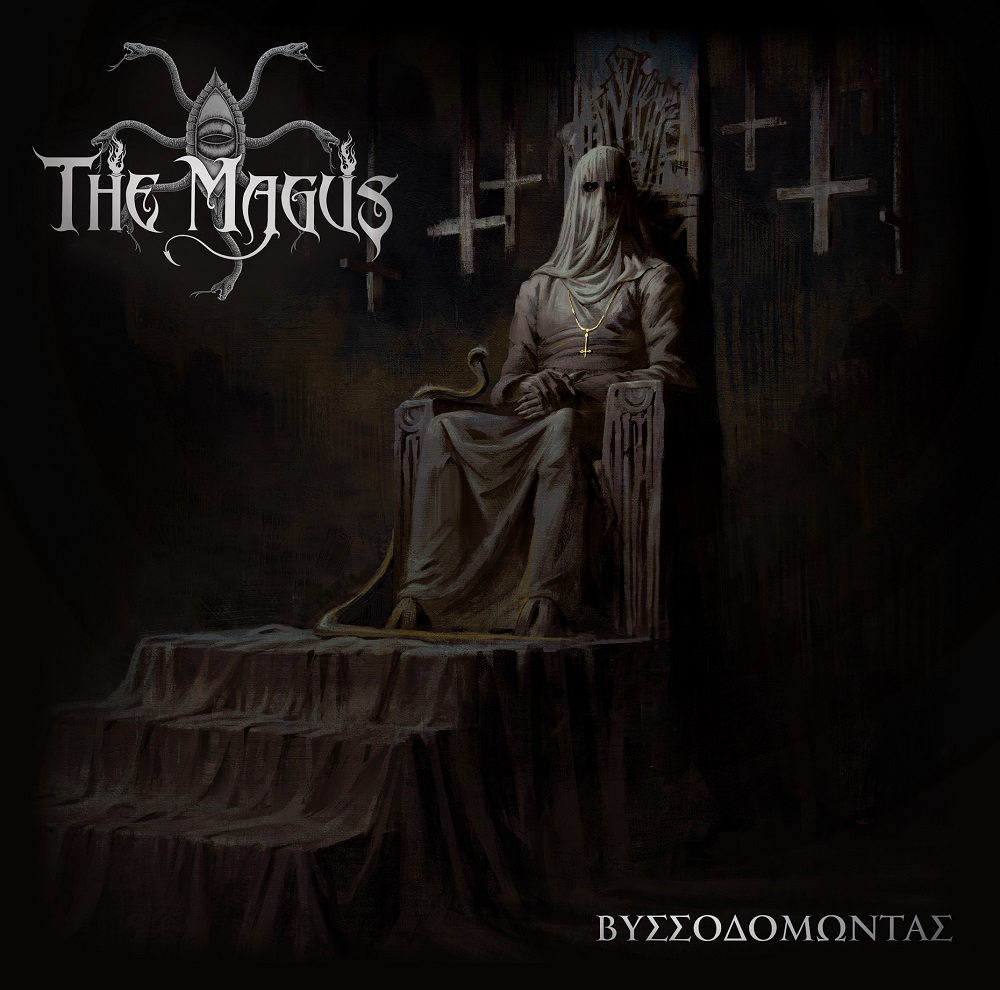
2021 saw the unfortunate but understandably final infernal descent of one of Greece’s most eminent names, but with that end comes new beginnings as THE MAGUS carries its lifeforce onward into other sonic incarnations, including now the debut of his own self-named entity titled ΒΥΣΣΟΔΟΜΩΝΤΑΣ. The significance of this word is realized from joining El on guitars alongside the drumming of Maelstrom, and all three members conspire deep in the abyssal shadows to forge beings composed of black and classic metal elements. These combinations forward epic and haunting forces amid the fierce permeating influence of darkness, and they reflect THE MAGUS’ unbound spirit while casting a dim glow on the mysteries, which forms an illuminating work that intends to collect its proper dues.
A reckoning is at hand when “This is My Church” initiates the ceremony, and its phantasmic magnitude builds in symphonies around an infernal oration, which escalates until “The Fall of Man” unleashes fury upon ingrates in arrangements promptly favoring the blackness. The intensity is channeled across multiple structures, with slower transitions breaking the frenzy to highlight the ghastly service of choirs, and a fretted course with harmonics elevates that energy alongside blast beats and a vehement vocal delivery. These elements invoke further variations of dread on “Lux Tenebrarum – The Illuminating Darkness,” after atmosphere is immersed within a haunting interlude, and its essence is matched by the ethereal tone following in a melody, demonstrating a dynamic perceived again later through the tranced-out euphoria of another lead. Its impact is capitalized in soloing that transfers notably to the drumwork beyond, and heavy rhythms are prominent among those developments, but they especially drive the title track’s malevolent procession, where chants and imposing organ keys effectively convey a ritualistic scene. Madness proliferates in the textural details of its passages, including the slow masses imbued with clean notes and pianos, and the inherent classic metal substance also enhances some grooved areas, while heavier forms conspire with vocals to leave their venomous words coursing deep.
Many riffs are distinguished sonically by certain muting techniques, and “Idolatrous Discord” highlights this along with a rhythmic versatility directed through its underworld. Classic methods develop on both thrashy and melodic levels, with multiple leads raising their power toward epic points, and similarly complex formulas take an atmospheric focus on “Ama Lilith.” Its riffing is joined with choirs and other traditional instruments to reflect an ancient Near Eastern spirit, and the depth of their ritualistic focus peaks with a female voice personifying the entity in question. A possession carried in vocal effects introduces “Negative Renaissance,” where divergent tremolos lead into the madness of serpentine fret courses, and they almost become hallucinogenic when combined with drum maneuvers of parallel turbulence and dark aural waves. Higher euphoric planes are melodically harmonized before reaching “The Peacock King,” and the cooperative riff and percussive arrangements here are a driving force, which is then embedded with choral and melodic layers for a sustained grandiosity arriving at “Give the Devil His Due – The Story.” This mighty finale captivates with an opening diner scene and narration, and these are matched with a bluesy or jazz element in the leadwork and piano sections that emerge throughout its darker collective. The visceral energy among its mass of heavy rhythm, ambience, and vocal projections is particularly striking, and organ keys eventually take lead over this summoning to close its affirmations of infernal glory.
A spellbinding multitude emanates likewise from the lyrical depths, and their dark workings herald Lucifer as a prime and imposing force on “This is My Church.” The occult significance is noted in several lines detailing his contributions to humanity, including the liberation and enlightenment gained “Through the Black Flame of Gnosis,” and being marked with “The sign of the Serptagram” captures the distinct spirit of this new order. Disdain toward Mankind is evident after devolving in spite of these gifts, and that misanthropy becomes more pointed on “The Fall of Man,” where vengeful acts call to “Paint my canvas with the shades of destruction” and “Scatter their souls into nothingness.” Man is further deemed “A decomposing piece of art,” and this wrath extends to Kabbalistic areas that “Eclipse the sun of Tiphareth” before “Lux Tenebrarum – The Illuminating Darkness” arrives. Its “Winged sinister giants” abolish holy influences in favor of “The Black Light of Lucifer,” an empowering force which spurs a transformative process “As the cosmic core is devoured by the abyss,” and this deep realm becomes the focal point for atrocities carried out on “ΒΥΣΣΟΔΟΜΩΝΤΑΣ (Vissodomontas).” There are “Spells of abomination” detailed in “We carve the inverted icons,” and they aim to “Ignite the fires of depravity and pain” while coursing “Through the channels of Gaia.” This reference merges ancient mystique with the malevolence for a deathly eminence that only intensifies throughout.
Those shadows persist “As the Primal Gods return to their thrones” on “Idolatrous Discord,” and one forwards “Chaos and suffering” while both Ouroboros and Lucifer are noted in revelations involving “The Great Worm” and “The Serpent of the Morning star.” A potent eucharist is then consumed amid the dread of “All hope is dead and gone,” and another entity is also partly described in serpentine form when taking the mythological aspect to Mesopotamia on “Ama Lilith.” This “Queen of Sitra Ahra” and “Elder Harlot of sexual magick” is harnessed to achieve further levels of transcendence, leading next to a cosmic upheaval in “Sowing the Tree of Death” on “Negative Renaissance,” and the Eternal Serpent is recalled again when “Head biting the tail” depicts the endless struggle of existence. This turmoil extends to “The Cosmic Opposer” of “The Peacock King,” where a conception or “Proto-malefic union” occurs between this “Monarch of the Shadow” and “The Qliphotic Nun,” and its conclusive lines effectively convey how the “Liberating madness” of this path is “Communicated through the Venom of the Adversary.” Like Ouroboros, the venture comes full circle on “Give the Devil His Due – The Story,” with Mephistopheles coming to claim one described as “A wretched soul of cruel heart,” and this individual foolishly believes he is in for a rapturous trip. A contrary outcome awaits instead, and explanations for it, including how “You became a slave to them” and “Failed to love and to be loved,” drive the importance of maintaining control over vices, which decisively seals the concentrated depth of these verses.
THE MAGUS continues to expand his legacy through this new endeavor, and it conjures a fierce amalgam of both the blackened extremes and traditional heaviness, with rites harnessing effective combinations of chaos and wrath alongside various grooved melodic formulas. These attain many remarkable points throughout, where leadwork and the vehement forces projected vocally often further their impact, and they resound across unseen planes while organ keys join other auras that enhance an inner temple dynamic. Guest contributors are also notable in bringing another level of immersion to the concepts unfolding within, and its shadowy themes radiate from an abyss exalting ΒΥΣΣΟΔΟΜΩΝΤΑΣ as a work of supreme Luciferian art, which affirms THE MAGUS’ adept stature and inspires fervent devotion to this latest era.
 themisanthreport.com