
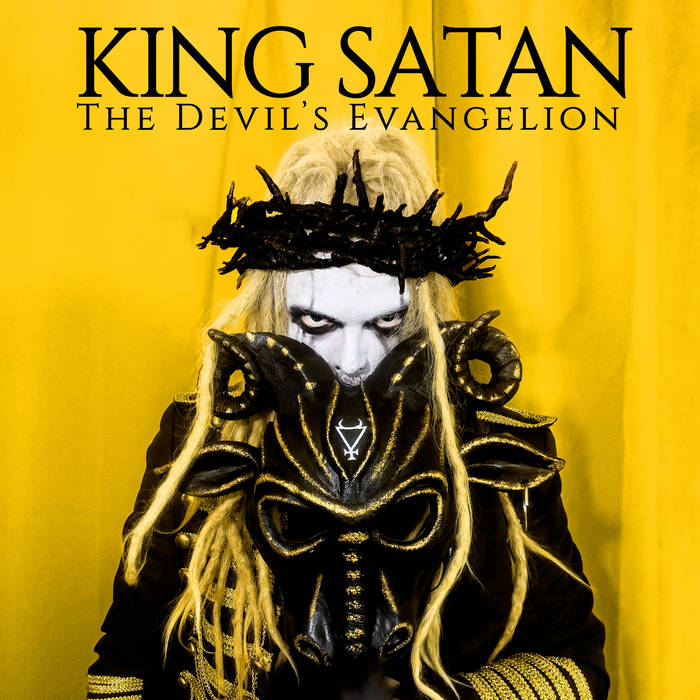
Our (un)worldly existence isn’t getting any less bizarre, and delving through the stranger parts of its hidden mechanics is the specialty of renowned Finnish eccentrics KING SATAN, who’ve concocted another batch of chaotic formulae to incarnate their next era. The result is an opus which basically follows where 2022’s Occult Spiritual Anarchy left off, and as its title suggests, The Devil’s Evangelion delivers favorable and expansive messages of sound that boldly defy conventionality. Those arrangements are matched by themes centered around the contrary interconnections between seemingly opposed elements, and they meld together with the charge of KING SATAN’s energy to yield a mesmeric and thought-provoking exploration.
Order rises among the outward disorder of this elemental myriad, with synth and riff configurations that maintain a core melodic harmony while cooperating rhythmically over their separate courses, and dynamics quickly unfold in the different techno features laced over passages using militant or industrialized percussive grooves. Pete Hellraiser’s live drumming is proven vital again as blast beats and other deathly maneuvers carry the arrangements epically into symphonic black metal areas, and those stylistic fusions generate energies in the performance that are further driven by a fierce and sometimes utterly berserk vocal delivery, which couldn’t have been easy to deliver with the injury King Aleister Satan endured from a car accident at the time of recording. Some arrangements are enhanced on another level from the singing of Hekate Boss, and a solo punctuates her alluring effect on “Abyss of the Souls,” capturing a mighty culmination that continues to escalate when her verse is taken over by King Aleister Satan near the end.
The melodicism of leadwork effectively marks a few more evocative points, and it also exhibits a virtuosic counterpart to riffing that is mainly composed of heavy and rhythmic structures. There are other intricacies noted throughout, like intervallic fret patterns aligned to the core melody of “Once Upon a Shadow,” and symphonic elements there contribute an elegance while illustrating varieties that deviate from the main presence of carnival-styled keys. This continues with darker piano auras at the beginning of “A Death Before Death,” and a lighter riff dissonance resonates among the progressions before synths are refocused with their own soloing effect. “The Carnivalesque of Dark & Light” sees both metal and electronic features conspiring madly, and the flow of slower arpeggiated notes is found giving balance to the frenzy within its grooved alternations. “Destroy the World” is reimagined with a notable and expansive solemnity, which is then transferred to a brooding riffage and beat initiation on “The Devils and Saints,” and these powers are greatly enhanced by the psychedelic influences running through its composition. Pace demonstrates its impact in the slowed entrancement of “Satanas Rex Mundi,” and after a striking title track, “Epilogue (The Phoenix Song)” is distinguished by an oddly familiar piano and lead melody to conclude this exercise of unbounded aural potential.
Illumination advances when considering various lyrical points, with “New Aeon Gospel” heralding an age where the nature of dualities and the True Will are brought to light, and the accompanying scriptures describe us engagingly as being “Its letters painted with the blood of gods.” This seems to reflect our ascent beyond different belief systems over time, but a resistance to that evolution is also present, and “Abyss of the Souls” observes it in the tendency of most humans, who would “Crucify their own prophets and worship them after they fall,” to remain oblivious and enslaved by the prevailing physical paradigms. Reverence for the knowledge and liberation of discord prevails on “Chaos Forever Now,” and a line from SATURNIAN MIST’s “The True Law” reappears in this context, which after reviewing both tracks might suggest an alignment between them harnessing chaos to fulfill the True Will. Examinations of The Self progress into confronting its darker aspects during “Once Upon a Shadow,” and they are ultimately embraced while “I hate the power you have, in reality I rejoice in it” effectively channels that conflict through the overarching interconnection between opposites. “A Death Before Death” applies this to themes of creation after destruction of The Self, along with bits of wisdom gained from such ordeals, including one quoted piece about choosing thoughts cautiously since we inevitably turn into them.
Opposites clash again during “The Carnivalesque of Dark & Light,” and aims to pierce the outward veil are noted while “A host of counterbalance to create a change, to vivify suffocating reality” illustrates one role of the Devil’s archetype. The annihilative calls of “Destroy the World” fit the surrounding context before “The Devils and Saints” presents a dialogue between a priest and fiend, where the priest’s claims of religion offering love and comfort are countered by the fiend’s likening of churches to prisons that maintain order through fear. An interesting idea here also suggests that all humanity focusing on its limited time in this world instead of potential afterlives could promote our collective ascension. Lines like “I am the shadow of all the shadows, perfecting the light above nature” fully embody the Devil’s archetype on “Satanas Rex Mundi,” with its interplay of opposites extending to the relativity of “Being a messiah in one story means you are a Satan in another,” and the title track follows with a Garden of Eden scenario affirming Satan as the true liberator. Its message of personal empowerment and accountability is received well in “You are your own redeemer” and “If you don’t control yourself, something always will,” and “Epilogue (The Phoenix Song)” reflects a conclusive revelation in “It is clear that everything’s one and the same.” The philosophy runs deep throughout these passages, and though my understanding of it is incomplete, there is obviously a lot to contemplate and inspiration to be found within.
KING SATAN continues to imbue the metal genre with their distinct breed of chaos, and this new manifestation has left its mark deep in the sonic collective, with an eclectic mix in its compositions that demonstrate a further honing of what was achieved on their past efforts. The fusions between synths and heavy distortions over various entrancing and turbulent beats form a somewhat peculiar but also highly captivating experience, where a spectrum of darkness and light is captured atmospherically along with a visceral force in the execution, and this effectively drives the arrangements to achieve spellbound states of transcendence. Those open to possibilities outside the traditional spheres will find much to admire here, and it will also be interesting to see what enlightenments will follow in the next chapter of this becoming gospel, but until that time arrives in this absurd existence we find ourselves in, The Devil’s Evangelion revels in the extraordinary for revelations to be hailed with an emphatic “Fuck the rest Satan is best!”
 themisanthreport.com