
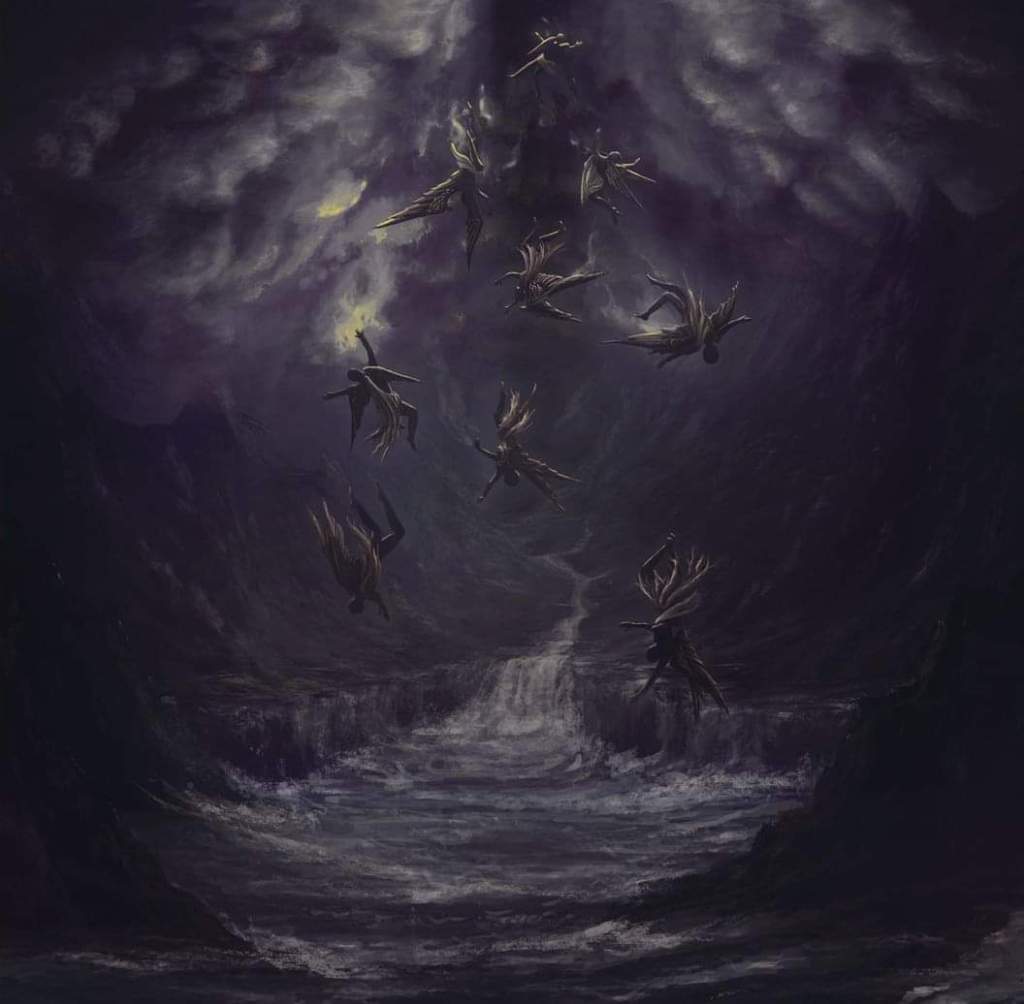
Several years have passed since our existence was marked by the first part of a mighty grimoire, and its shadowy tides have now extended to the latest offering titled Liber Lvcifer II: Mahapralaya. These collective rites chronicle the next evolutionary level of THY DARKENED SHADE, with chaos harnessed alongside grandiose atmospheric conjurings, and those formulas prove devastating as they raise the most dreaded of malevolent forms. The darkness congeals as Liber Lvcifer II: Mahapralaya orchestrates a glorious fall from grace, which is favored in the pursuit of heinous paths that lead to greater consciousness, and the highest is attained through THY DARKENED SHADE’s adept craft while venturing gloriously into depths of dissolution.
A solemn initiation proceeds in the arrangements of “Luciftias,” and various sung dynamics elevate the grandeur around a blasting glimpse into madness, which “Sacrosanct Pyre” soon liberates fully in a wrathful torrent. Intricate and malign riff designs are gathered alongside unpredictable percussive shifts, with a vast materializing abyss reflected as structures from both elements expand indefinitely, and the intensity only subsides enough to highlight infernal praises and invocations. My experience would normally attribute the degree of wizardry in these courses to certain death metal tendencies, but their blackness is asserted intriguingly when fleeting arpeggiated glares emerge in the mix. Similarly tortuous maneuvers reverberate “Into Eerie Catacombs,” where dissonant shapes are rampant among the virtuosic storm, and infusing the frenzy with slower grooves draws focus on a sinister eminence, along with clean strings dissipating to the dread of choirs before “Satanastasis” takes hold. The continued influence of steady rhythms brings out its cold mayhemic auras, and they compound the vile priestliness of vocals while traversing notable developments, including pointed melodies that culminate amid other detailed currents raging through perpetually dim regions.
The songcraft exhibits a different side on “Qelippot Epiphany,” and it raises atmosphere as bells align with the melody of a choral and clean-stringed presence. Another distinguishing trait is noted in its relatively open composition, which gives space to emphasize drumming complexities and riff masses that densify beneath the steadfast pace, and a dark splendor is exalted until energies reconcentrate for an upheaval transferred to “Acausal Current of Thanatos.” Its labyrinthian fretwork becomes menacing when arpeggiations resonate across rapid blasts, and ancient spirits manifest by channeling other thunderous beats and horns into the rite. Turbulence escalates while advancing toward an end punctuated chorally, and the last sung pitch seems to sound a bit off, but this was likely intentional to reinforce the overall dissonance and torment. These elements persist relentlessly on “Veneration for the Fireborn King,” with combined heavy and noted progressions marked within its frantic sequence, and “Noxious Witchery of the Titans” follows in a fury of intricate blast-beaten designs that seizes the peak of this extremity. A second culmination haunts through the notes and chords traversing a break in the chaos, and their eeriness is magnified by spoken tones before an engulfing technical whirl reaches “Typhonian Temple,” where the material shifts for a grand contrast that achieves transcendence and a triumphant completion.
Darkness is also unbounded throughout the incantations, and their serpentine persuasion is apparent at the opening of “Luciftias,” with its quote alluding to a grand transformation after partaking in the forbidden. This chosen path leads to exaltations that capture the Luciferian essence on “Sacrosanct Pyre,” including its regard as a “Noble baleful god” and the “Quintessence of enlightenment,” and “The astral feast commences” for a ritualistic approach to union with this deity before delving “Into Eerie Catacombs.” Further praises here combine with a self-offering “To enter the empire of thy grandeur,” and “Acausal nightside currents” are summoned, along with other forces aimed toward eradicating “Thy abhorred antagonists” and “Imperfect forms of creation.” That cleansing aspect of chaos is further observed “Tearing down the malefic shroud of life” on “Sathanastasis,” and conjurations continue when the pestilence-spurring dragon, Tanin’iver, appears. Its direction to “Bind Gamaliel with Thaumiel” highlights the Qliphotic nature of this working, and “Uniting the eleven into one supreme dragon” reflects another level of attainment forwarded apocalyptically.
The liberated significance of eleven lingers in the “Serpents hissing my burial anthem” on “Qelippot Epiphany,” and other acts carried “Through nightmares and chants clandestine” unveil “Sigils from Harab Serapel,” which reflects a ravenous form of Death before shifting to its Hellenic variation on “Acausal Current of Thanatos.” The Qliphoth manifests as he “Pierces Daath to envenom the tree of life,” with the atmosphere of this “Realm of Sitra Ahra” portrayed among “The Deepness of obscure labyrinths,” and multiple infernal names are encountered there until “Veneration for the Fireborn King” arrives with “Torment that brings forth cataclysm.” Such ordeals are inevitable when “Embracing the insight of Baphomet’s horn,” and they extend alluringly to a Norse perspective on “Noxious Witchery of the Titans.” The ultimate aim is paralleled in its “Return into the yawning void of Ginnungagap” as Ragnarök ensues, and perseverance through “The anguish of existence” follows on “Typhonian Temple,” where uniting with the infamous Greek dragon finalizes an impressive pantheon evoked across these rites. Attempts to cover every noteworthy point here would be excessive, and though much of the contents also lie admittedly beyond my experience, a core understanding suffices to inspire further interest and appreciation for their meticulous substance.
The chasm between parts I and II of Liber Lvcifer, without taking from the significance of multiple splits released across its duration, is understandable considering the depth and detail of this colossal effort. Its complex song structures reflect an abyss to transcend material awareness, and a highly engaging mass is perceived through the myriad of shapes circulating amid its madness. Instrumental dexterity is apparent in frenzied or erratic pulses that alter for calculated strides, and the malignant forces they amplify are also projected by fervent vocal dynamics, along with sung sections from those likened to a choir of fallen angels. They drive the ritualism further within each hymn, and certain atmospheric subtleties act as another complement to this collective, which maintains the AOTY contendership it seized at the onset of this year. THY DARKENED SHADE will easily continue drawing those who favor dark and technically potent compositions with Liber Lvcifer II: Mahapralaya, and its turbulent designs will keep black fires burning formidably into the aeons ahead.
 themisanthreport.com